90-Day AI Enablement for UK professional teams
A structured 90-day follow-on for a named team of 10 to 25 users, not another standalone session
The 90-Day Enablement subscription is scoped for two triggers. The first is a firm that has run an Executive AI Briefing or a half-day workshop, and whose adoption has plateaued at two or three enthusiasts and a lot of silent licences. The second is a firm that wants a documented, measured next 90 days tied to one or two specific workflows, rather than another standalone training session. Delivered by one named facilitator across the full 90 days, through The AI Consultancy (London) Ltd.
- For teams of 10 to 25 users at UK firms with 20 to 500 employees
- Vendor-neutral, no reseller commissions
- A trading style of The AI Consultancy (London) Ltd
What 90 days looks like
Six delivery blocks across the engagement: scoping, kickoff, prompt library build, bi-weekly office hours, a mid-point checkpoint at day 45, and a day-90 impact assessment. Sequencing is fixed; the workflows in scope are set in writing at the scoping call before the engagement starts.
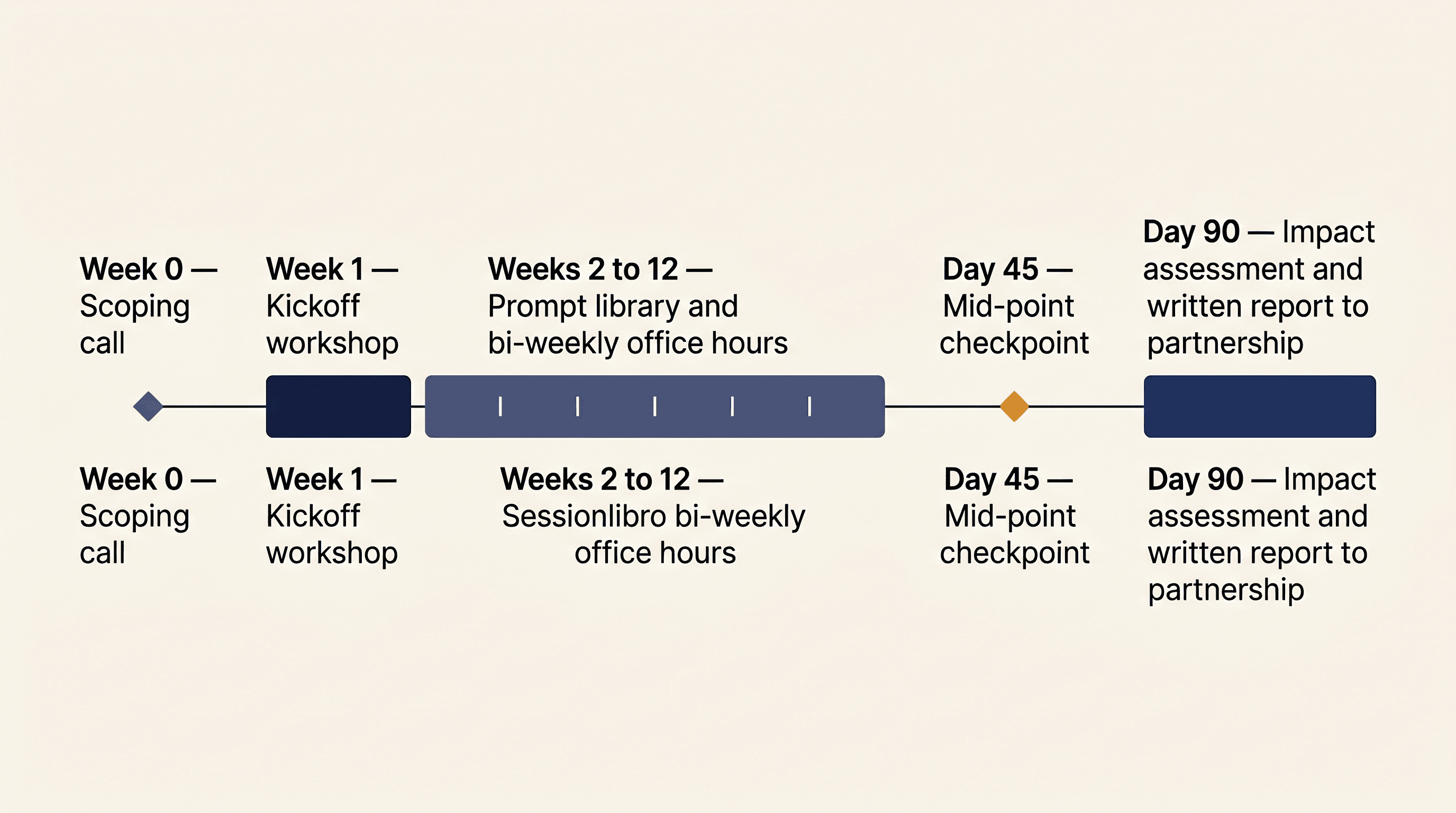
Week 0
Pre-engagement scoping call
A 60-minute call with the team lead, the Operations Director or function head, and the named facilitator. Agrees the team in scope (10 to 25 named users), the one or two priority workflows the engagement will measure against, the data the facilitator needs access to, and the two baseline indicators the day-90 note will compare against. No deliverables ship until this call is held in writing.
Week 1
Kickoff workshop
Half-day live session for the full team in scope, in-person or virtual. Sets the rules of engagement for the 90 days: which AI tools are in use, where a named reviewer sits, what data may and may not be pasted into consumer-grade tools, and how the team records what AI suggested against what the reviewer accepted. Written summary issued within five working days.
Weeks 2 to 12
Prompt library build
A curated prompt library tuned to the team's actual workflows, built iteratively through the 90 days rather than handed over as a finished artefact on day one. Prompts are versioned, commented with the reason the pattern exists, and mapped to the workflow they sit inside. The firm owns the library outright at the end of the engagement and can continue to edit it without Learn AI's involvement.
Weeks 2 to 12
Bi-weekly office hours
Six 60-minute office-hours sessions across the 90 days, scheduled every two weeks. Open drop-in for the team to bring live examples: prompts that are not working, outputs that look wrong, review steps that are slowing the workflow down, and governance questions the function head wants a second view on. Notes from every session are added to the prompt library and the running finding list.
Day 45
Mid-point checkpoint
A 90-minute review with the team lead and the function head. Covers adoption so far (which team members are actively using the tools, which are not, and why), a first read on the two baseline indicators agreed at scoping, and any course correction needed for the second half of the engagement. Output is a dated mid-point note the function head can share internally if useful.
Day 90
Impact assessment and written note
A half-day session closing the engagement. Covers the day-0 versus day-90 comparison on the two agreed indicators, a documented audit trail of what AI touched which workflows, the final handover of the prompt library, and a recommended next-step decision for the firm (roll the pattern to a second team, hold and consolidate, retire the tool, or extend). Output is a written note addressed to the partnership or Managing Director.
What you leave the 90 days with
Five outcomes, in the language a Finance Director, Operations Director, Managing Partner, HR Director, or Marketing Director would use when briefing the partnership or the executive committee.
Adoption moved from individuals to supported team practice
“AI use across the team is no longer a handful of experimenters on personal accounts. We have a named set of tools, a named reviewer step on every AI-touched output, and a team that is using the same rule set.”
Measurable indicators on cycle time and hours returned
“We have a day-0 baseline and a day-90 comparison on the two indicators we agreed at kickoff (typically cycle time on a recurring deliverable, and hours returned per week per team member). The partnership conversation is now about the delta, not the tool.”
A curated prompt library the firm owns
“The team has a versioned prompt library tuned to our actual workflows, commented with the reason each pattern exists. We own it outright; we can edit, extend, or retire any of it without Learn AI's involvement.”
A documented audit trail on AI use
“For every workflow the engagement touched, we have a dated record of what AI proposed, who reviewed it, and what went to the client or the ledger. That record sits alongside the firm's existing governance, not in a separate parallel file.”
A next-step decision ready by day 90
“By day 90 we have a written note addressed to the partnership or Managing Director: roll the pattern to a second team, hold and consolidate, retire the tool, or extend the engagement. The decision is scoped and dated, not a wish list.”
90-Day Enablement: pricing
A single fixed price with a transparent inclusion and exclusion list. The fee covers the work described below across the full 90 days. There are no separate retainers, onboarding fees, or add-ons applied after booking. Licence fees for third-party AI tools are paid directly by the firm to the relevant vendor.
Per session, half-day, 6 to 12 leaders
£8,000
For a team of 10 to 25 users over 90 days. Billed on booking confirmation after the pre-engagement scoping call. Delivery is virtual by default; in-person sessions for the kickoff and day-90 assessment are charged separately if delivered outside London.
What is included
- Pre-engagement scoping call with the team lead and function head (60 minutes)
- Kickoff workshop for the full team in scope (half-day, in-person or virtual)
- Curated prompt library tuned to the team's actual workflows, versioned and commented; the firm owns the library outright at the end of the engagement
- Six 60-minute bi-weekly office-hours sessions across the 90 days
- Day-45 mid-point checkpoint with the team lead and function head (90 minutes)
- Day-90 impact assessment session and written note addressed to the partnership or Managing Director
- One named facilitator from the Learn AI delivery bench, confirmed in writing before the engagement starts
What is not included
- Licence fees for third-party AI tools (Microsoft Copilot, Google Gemini Workspace, Anthropic Claude, OpenAI ChatGPT, sector-specific overlays)
- Data migration, integration build, or configuration of AI tools into the firm's existing systems
- A Data Protection Impact Assessment (DPIA) signed on the firm's behalf; Learn AI contributes the findings, the firm's Data Protection Officer signs the DPIA
- Formal legal, regulatory, or tax advice on a specific matter (refer to the firm's solicitor, auditor, or compliance function)
- Executive AI Briefings or half-day sector workshops (priced separately and typically delivered before the subscription starts)
Questions a function head asks before booking the subscription
Eight questions we hear most often on the 90-Day Enablement subscription specifically. Straight answers, no regulatory claim we cannot defend.
What is in scope across the 90 days, and what does the fee actually cover?
- The engagement covers a named team of 10 to 25 users, one or two priority workflows the team already runs, and the six delivery blocks set out above (scoping call, kickoff workshop, prompt library build, bi-weekly office hours, day-45 checkpoint, day-90 impact assessment). The fee covers the facilitator time, the prompt library work, the written summaries, the mid-point note, and the final day-90 note. Licence fees for third-party AI tools, integration build, and any DPIA sign-off sit outside the fee.
How are teams sized, and what happens if the team is bigger or smaller?
- The published price range assumes a team of 10 to 25 named users. Teams below 10 can be served by a half-day workshop or Executive Briefing instead, not by a full 90-day subscription, because the bi-weekly office-hours cadence needs a minimum caseload to be useful. Teams above 25 are typically split into two phased engagements (one team for the first 90 days, the second team for the next 90 days) rather than stretched across a single larger cohort, because the prompt library build quality drops above roughly 25 active contributors.
What do the day-45 and day-90 checkpoints actually contain?
- Day-45 is a 90-minute review with the team lead and the function head. It covers active adoption across the team, a first read on the two baseline indicators agreed at scoping, and any course correction needed. The output is a dated mid-point note. Day-90 is a half-day session that closes the engagement: day-0 versus day-90 comparison on the agreed indicators, a documented audit trail of what AI touched which workflows, the final prompt-library handover, and a written next-step recommendation. Neither checkpoint is a presentation deck; both are working sessions that end with a written note.
How is the prompt library curated, and what does handover look like?
- Prompts are built iteratively across the 90 days, starting from the team's existing workflows rather than from a generic template. Every prompt is versioned, commented with the reason the pattern exists (the specific workflow, the risk the prompt is guarding against, the reviewer step that sits after it), and mapped to the workflow it sits inside. The handover at day 90 is a plain export in a format the firm can edit: Markdown, JSON, or a shared document inside the firm's Microsoft or Google tenancy, depending on where the firm already keeps working content. The firm owns the library outright.
Are you vendor-neutral, and how do we verify that?
- Yes. Learn AI takes no reseller commissions and carries no platform lock-in. The prompt library is built against the AI tools the firm has already licensed or is actively considering, not the tools Learn AI would prefer to sell. The delivery bench is trained across Microsoft Copilot, Google Gemini Workspace, Anthropic Claude, OpenAI ChatGPT, and the main sector-specific overlays in legal, finance, consulting, HR, and marketing. We are happy to put the commercial position in writing before the engagement starts.
What regulatory claim does the engagement make, and what does it not claim?
- We describe the UK regulatory touchpoints relevant to the team in scope (SRA principles for fee-earners, ICAEW / CIMA / ACCA competence for finance teams, UK GDPR and the ICO for any personal data processing, Equality Act 2010 and UK GDPR Article 22 for HR use, ASA and CAP Code substantiation for marketing use) and where they intersect with the workflows the engagement measures against. We do not claim accreditation, endorsement, or CPD-compatibility from the SRA, the Law Society, ICAEW, CIMA, ACCA, CIPD, the MCA, the ASA, CAP, IPA, or any other professional body unless the body has confirmed alignment to us in writing. Any advice that would bind the firm is signposted back to the firm's own solicitor, General Counsel, Finance Director, or Data Protection Officer.
Who is the facilitator across the 90 days?
- One named facilitator from the Learn AI delivery bench, confirmed in writing before the engagement starts. Either a senior associate from The AI Consultancy (London) Ltd or a certified partner trained against the same engagement shape. The facilitator runs the kickoff workshop, every bi-weekly office-hours session, the day-45 checkpoint, and the day-90 impact assessment, so the team is working with the same person for the full 90 days rather than a rotating bench.
What does follow-up look like beyond day 90?
- Day 90 ends with a written note addressed to the partnership or Managing Director, covering a recommended next-step decision. Most firms take one of four routes: roll the pattern to a second team (a fresh 90-day engagement), hold and consolidate (no further paid work, the firm continues on its own using the prompt library), retire the tool (the engagement surfaced that the tool is not the right fit), or extend the engagement (typically a further 90 days for a second workflow). None of the four is pushed by Learn AI; the firm owns the decision and the timing.
What function heads tell us after day 90
Attributions anonymised at role and firm-type level until named clients sign a usage permission.
“Ninety days gave us the cycle-time delta the partnership actually wanted. We went from three weeks on a proposal turnaround to eleven days, with a documented reviewer step on every AI-assisted section. The day-90 note made that conversation straightforward.”
Operations Director, UK management consultancy (50 to 100 staff)
“The prompt library was the piece we did not know we needed until we had it. By day 90 the team was using the same patterns without being told to, and the audit trail was sitting alongside the month-end pack rather than in a separate file.”
Finance Director, UK commercial law firm (30 to 50 fee-earners)
“We had a workshop six months earlier and adoption had drifted back to two enthusiasts and a lot of silent licences. The subscription was what moved the rest of the team. The day-45 checkpoint caught where we were slipping, and the day-90 note is what I took to the partnership.”
Managing Partner, UK consultancy (20 to 50 staff)
Built for UK regulated teams
Three commitments we carry into every engagement. Professional-body alignments are pursued once we have case studies to substantiate them.
GDPR-compliant by design
Assessment data is stored in the UK, minimised by default, and retained only for the term stated in our privacy notice.
UK-based and UK-regulated
A trading style of The AI Consultancy (London) Ltd, registered in England and Wales. Trainers and associates are UK-based.
Vendor-neutral
No reseller commissions, no platform lock-in. Training covers the tools your firm uses, not the tools we are paid to promote.
Start where you are
Pick the first step that matches where your firm is now. Each links through to a dedicated page.
- Read more
Case study
UK management consultancy moves AI adoption from experimenters to supported team practice
Anonymised case study from a UK management consultancy (20 to 100 employees). 90-Day Enablement subscription, proposal cycle time from three weeks to eleven days, a forty-two-prompt library the firm owns.
- Read more
Assessment
AI Readiness Assessment
Fifteen-minute diagnostic producing a personalised report on tool posture, skills gaps, and recommended next steps. Free, and a useful input to the pre-engagement scoping call.
- Read more
Offer
Executive AI Briefing
Half-day session for 6 to 12 senior leaders. Often the starting point before a 90-Day Enablement is commissioned for a named team.