For UK COOs, Operations Directors, and Practice Managers
AI for the operations function, wherever the firm's primary sector exposure sits
Role page for Chief Operating Officers, Operations Directors, Heads of Operations, Practice Managers, and Business Managers at UK mid-market firms with 20 to 500 employees. Written for the person who owns process design, vendor governance, and the ROI conversation with the partnership or Managing Director. Covers the operational mechanics of an AI rollout across the firm and the UK GDPR posture that sits beneath it.
- For operations functions at UK firms with 20 to 500 employees
- Vendor-neutral, no reseller commissions
- A trading style of The AI Consultancy (London) Ltd
Why AI lands on the Operations Director's desk first
The operations function owns the rollout, the vendor governance, the risk register, and the partnership conversation on whether the spend bought the firm anything. The figures below are broader UK workforce research reframed for an operations-role reader; each carries source, publication, and year.
- 97%
- of UK firms report an AI skills gap inside their own workforce, which shows up on the Operations Director's desk first as unevenly adopted tooling.
- 61%
- of professional services firms have abandoned at least one AI project, with skills gaps at leadership level cited as a primary cause. The operations function typically owns the post-mortem.
- 55%
- of C-suite leaders in professional services rate themselves as the least prepared group in their firm for AI adoption, leaving the Operations Director to translate intent into workable process.
Source: IBM Institute for Business Value, 2024.
Source: Skills England / DSIT workforce research, 2025.
Source: Skills England / DSIT workforce research, 2025.
What an Operations Director actually uses AI for in 2026
Six tasks a UK operations function runs AI against in 2026. Each describes the task, the role-specific question, and a plain-sentence answer that keeps governance and UK GDPR posture inside operations, not lost between IT and the individual teams.
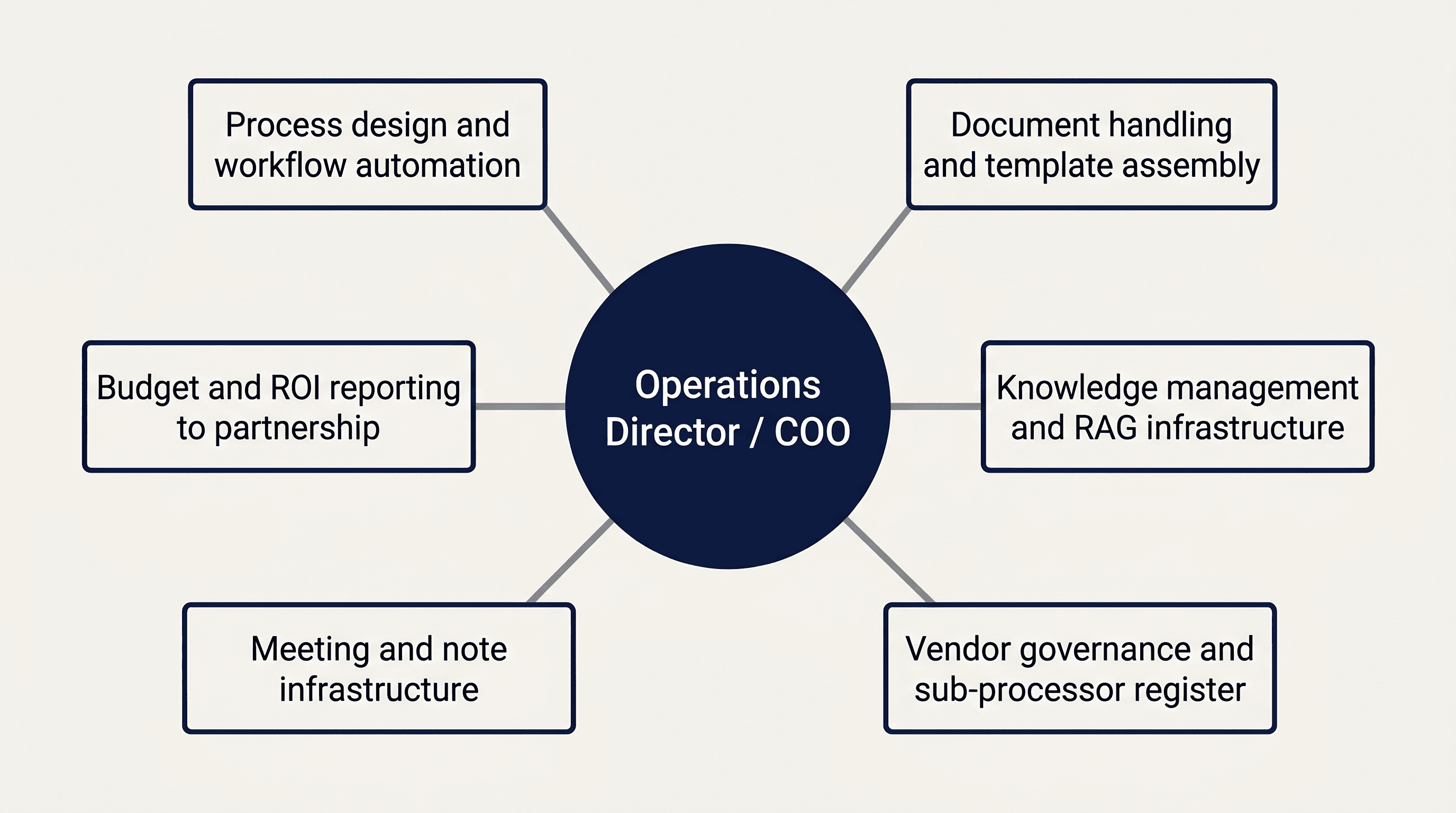
Process design and workflow automation
Where does AI sit inside an existing operational workflow without quietly breaking the handover points?
AI is strong at drafting, summarising, and routing inside a workflow that already has clear handover points. It is weak where the workflow relies on informal context held in someone's head. The workable pattern for operations is to map the workflow first, identify the handovers, and only then point AI at the drafting or triage steps. The goal is shorter cycle time with the audit trail intact, not a new opaque black box.
Document handling and template assembly
Can AI shorten document assembly for proposals, contracts, and client-facing packs without introducing a quality regression?
AI cuts the draft-one-pack time meaningfully when it is pointed at a structured template library, a prior example, and a clear scope note. The risk is the inverse: staff pulling AI drafts into external client output without a review step. The rule the operations function needs to circulate is that AI drafts are internal working documents until a named reviewer signs them off, regardless of how polished the first output reads.
Meeting and note infrastructure
Is AI transcription and meeting summarisation safe to roll out across the firm, given what it captures?
Transcription is now mature enough for mid-market use, and summarisation is often good enough for internal distribution. The operations question is consent, retention, and sensitive-meeting handling. Client calls under legal privilege, HR conversations, and regulated-sector meetings may need to be excluded outright. The workable posture is a short written rule on which meetings are recorded, a retention window tied to UK GDPR, and an opt-out path for any participant.
Internal knowledge management
How does the firm get staff AI answers grounded in the firm's own documents rather than in the open internet?
Retrieval-augmented generation (RAG) against the firm's own document library is the mid-market pattern in 2026. It reduces hallucination on firm-specific questions and keeps the original source visible. The operations function owns three questions on rollout: which documents are in the index, who can access them, and how out-of-date material is retired. Document hygiene becomes a live operational task, not a once-a-year clear-out.
Vendor governance of AI tools across the firm
What does an Operations Director need on paper to govern the AI tools staff are already using?
A mid-market UK firm in 2026 typically has between five and fifteen AI tools in use, many procured directly by individual teams. The operations function needs a register of the tools, the vendors, where data is processed, the lawful basis under UK GDPR, and the named owner inside the firm. The workshop produces a draft register the Operations Director can adapt. Sub-processor risk sits specifically on this list, because consumer-grade AI tools used by associates or sub-contractors are a common source of undeclared sub-processing.
Budget, ROI, and the partnership conversation
How does the Operations Director secure budget for AI work and show measurable return to the partnership or the MD?
The partnership or Managing Director wants a short answer on what AI spend bought the firm. The Operations Director needs two things on paper for that conversation: a projected impact on a small number of specific operational metrics (cycle time on proposals, hours returned per week per team, reduction in pack-assembly rework), and an actuals reading at 90 days. 90-Day Enablement is designed to produce that reading. Bespoke programmes are scoped for firms where the partnership wants a firm-wide AI plan rather than a functional rollout.
This summary is descriptive, not legal or compliance advice. Firms should confirm their own position with their Operations Director, General Counsel, COLP or DPO, and external adviser before adopting any AI tool across the firm. Learn AI is a trading style of The AI Consultancy (London) Ltd and does not provide legal or compliance services.
Three ways an operations function can start
A leadership-level Executive Briefing, a sector-specific workshop sized for the team with the largest AI exposure, and a 90-day enablement programme. Each is scoped separately and priced transparently. Operations Directors often start with the Briefing to align the partnership, then run a sector workshop for the team closest to client-facing AI use.
Executive AI Briefing
Half-day briefing for 6 to 12 senior leaders including the COO or Operations Director alongside the Managing Partner and other function heads. Sector-specific deck, pre-briefing call, written summary.
Outcome
The leadership team leaves with a defensible position on AI, a ranked shortlist of use cases, a governance gap analysis against the firm's current policy, and named owners for the next step. Suited to firms where operations wants the AI conversation to land at the partnership or board table, not only inside the function.
Price
£2,500
Per session.
Sector-specific half-day workshop
Half-day workshop for up to 20 staff, scoped to the firm's primary sector exposure. Available as Secure AI for Fee-Earners (Legal), AI for Finance Teams, AI for Consulting Teams, Responsible AI in Hiring (HR), or Marketing AI Lab. Operations Directors typically pick the workshop matching the firm's largest client-facing team.
Outcome
The chosen team leaves with a working set of use cases, a named reviewer step on any AI-touched client output, and a written internal guidance note the Operations Director can circulate. Operations can then repeat the workshop for a second team if needed.
Price
£950 + VAT
Per session, per team. Travel charged separately if delivered in person outside London.
90-Day Enablement
Kickoff workshop, bi-weekly office hours for 90 days, a curated prompt library tuned to the firm's workflows, and an impact assessment at day 90 written for the operations-to-partnership conversation.
Outcome
Adoption moves from individual experimenters to a supported team practice. At day 90 the firm has a documented record of which AI touches sat inside the operational audit trail, where measurable value appeared (cycle time, hours returned, rework reduction), and a clear next step before any further investment decision. The day-90 note is written so the Operations Director can hand it to the Managing Director or partnership directly.
Price
£8,000
For a team of 10 to 25 users over 90 days. Scoped in a pre-engagement call.
Questions an Operations Director asks before booking
Eight questions we hear most often from COOs, Operations Directors, Practice Managers, and Business Managers. Straight answers, no regulatory claim we cannot defend.
Is AI an IT problem or an operations problem inside a UK firm?
- Both, but operations owns more of it than most firms realise. IT runs the tenancy, the identity provider, and the endpoint policy. Operations owns process design, vendor onboarding, the risk and compliance register, staff training, and the ROI conversation with the partnership. When AI is treated as purely an IT project, the firm tends to end up with a licensed tool no one uses and a governance gap the Operations Director has to close later.
How does an Operations Director build a vendor governance register for AI?
- A practical register carries the tool name, the vendor, where data is processed and stored, the UK GDPR lawful basis, the named owner inside the firm, the procurement route (direct firm licence, departmental licence, or free tier), and a review date. The workshop produces a draft register the Operations Director can adapt, specifically including the common case of associates or sub-contractors using their own AI tools on client work without formal procurement.
What does a good AI rollout look like from an operations perspective?
- Start with one team, one workflow, and a written guidance note before any licence is bought. Measure cycle time and rework at week zero. Introduce the AI step with a named reviewer. Re-measure at 30 days and again at 90 days. Decide whether to roll the pattern to a second team or to stop. The 90-Day Enablement offer is designed around this shape. A firm-wide rollout without a functional pilot is the pattern that shows up in the 61% abandonment figure.
How do I show AI ROI to the partnership or the Managing Director?
- Pick two or three operational metrics the partnership already tracks (proposal turnaround, analyst hours per engagement, review throughput, pack-assembly time). Establish a baseline before AI is introduced. Introduce the AI step with a named reviewer. Report the delta at 90 days. The partnership conversation is then about the delta, not the tool. 90-Day Enablement produces the baseline, the intervention, and the day-90 note in one scoped engagement.
What goes in the risk register the first time an AI tool is introduced?
- The register should name the tool, the data it sees, the UK GDPR lawful basis, the sub-processor chain, the fallback if the tool is unavailable, the reviewer step that sits in front of any client-facing output, the staff training position, and the owner. The Operations Director and the firm's General Counsel, COLP, or DPO jointly sign off. Learn AI describes the expected contents; the firm owns the decisions and the sign-off.
How do I handle staff using AI tools the firm never procured?
- Assume it is happening and build the position from there. The working rule is three lines: a short list of approved tools for specific data categories, a clear prohibition on pasting client-confidential or special-category personal data into consumer-grade tools, and a named route to get a new tool reviewed quickly. The workshop produces the first draft of all three. A purely prohibitive rule tends to push AI use underground; a permissive rule without guardrails breaks UK GDPR.
What is the UK GDPR position an Operations Director should hold on AI?
- AI tools that process personal data are processors under UK GDPR. The firm needs a written lawful basis, a sub-processor list, a data transfer mechanism for any processing outside the UK or EEA, and a position on data subject rights including access and erasure. Consumer-grade AI tools rarely give the firm a usable version of any of these. Enterprise tenancies of the main tools (Microsoft Copilot, Google Gemini Workspace, Anthropic Claude, OpenAI ChatGPT Enterprise) can be configured to sit inside the firm's existing UK GDPR posture, but only if the operations function takes that configuration seriously.
What does follow-up look like after the workshop or briefing?
- A written summary goes out within five working days, typically covering the rollout steps, the draft vendor register, the risk-register line items, and the ROI-measurement proposal. A thirty-minute follow-up call is offered at no additional cost. Further work (90-Day Enablement, bespoke operations-led AI programmes) is priced separately and scoped only if the firm asks for it.
What operations leaders tell us after a workshop
Attributions anonymised at role and firm-type level until named clients sign a usage permission. Full case studies will follow in Phase 2.
“We went in thinking we needed an AI strategy and left with an AI register and a rollout plan. That was more useful than the strategy deck would have been.”
Chief Operating Officer, UK commercial law firm (30 to 80 fee-earners)
“The workshop gave me the two metrics I needed for the partnership conversation: cycle time on proposals and review throughput. Those numbers now sit in the monthly pack.”
Operations Director, UK management consultancy (50 to 100 staff)
“For the first time I can tell our partners where the AI spend goes and what it bought us, at 90 days, on paper. That had not been possible before.”
Practice Manager, UK multi-office accountancy firm
Built for UK regulated teams
Three commitments we carry into every engagement. Professional-body alignments are pursued once we have case studies to substantiate them.
GDPR-compliant by design
Assessment data is stored in the UK, minimised by default, and retained only for the term stated in our privacy notice.
UK-based and UK-regulated
A trading style of The AI Consultancy (London) Ltd, registered in England and Wales. Trainers and associates are UK-based.
Vendor-neutral
No reseller commissions, no platform lock-in. Training covers the tools your firm uses, not the tools we are paid to promote.
Where operations leaders go next
Start with the Assessment, then follow the thread that matches where the firm is now. Each link is a dedicated page.
- Read more
Assessment
AI Readiness Assessment
Fifteen-minute diagnostic producing a personalised report on tool use, skills gaps, and a recommended next step across the firm. Free, and a useful baseline for an operations-led rollout.
- Read more
Offer
Executive AI Briefing
Half-day briefing for 6 to 12 senior leaders. Useful where the AI conversation has to land at the partnership or executive committee table, not only inside the operations function.
- Read more
Role
For Finance Teams
Sibling role page for Finance Directors and Financial Controllers. Covers the finance-function use cases, ICAEW / CIMA / ACCA competence framing, and the audit-trail rules that often intersect operations governance.
- Read more
Sector
AI for UK law firms
Sector page for UK legal practices. Useful where the Operations Director sits inside a firm with a large fee-earner base and SRA competence obligations on AI use.