For UK Finance Directors and Financial Controllers
AI for the finance function, whichever sector the firm sits in
Role page for Finance Directors, Financial Controllers, Heads of Finance, Management Accountants, and Finance Business Partners at UK mid-market firms with 20 to 500 employees. Written for the finance function inside any sector, not only accountancy practices. The focus is what a finance team actually uses AI for in 2026, where ICAEW, CIMA, and ACCA professional competence sits, and how to stop consumer-grade AI tools undermining the audit trail.
- For finance functions at UK firms with 20 to 500 employees
- Vendor-neutral, no reseller commissions
- A trading style of The AI Consultancy (London) Ltd
Why the finance function is the pressure point on AI governance
Finance Directors carry the audit trail, the statutory accounts, and the board conversation on ROI at once. The figures below are broader UK workforce research reframed for a finance-role reader; each carries source, publication, and year.
- 97%
- of UK firms report an AI skills gap inside their own workforce, including the finance function.
- 61%
- of professional services firms have abandoned at least one AI project, with skills gaps at leadership level cited as a primary cause.
- 55%
- of C-suite leaders in professional services rate themselves as the least prepared group in their firm for AI adoption.
Source: IBM Institute for Business Value, 2024.
Source: Skills England / DSIT workforce research, 2025.
Source: Skills England / DSIT workforce research, 2025.
What a Finance Director actually uses AI for in 2026
Six use cases a UK finance function runs AI against in 2026. Each describes the task, the role-specific question, and a plain-sentence answer that keeps the audit trail and the Financial Controller's judgement intact.
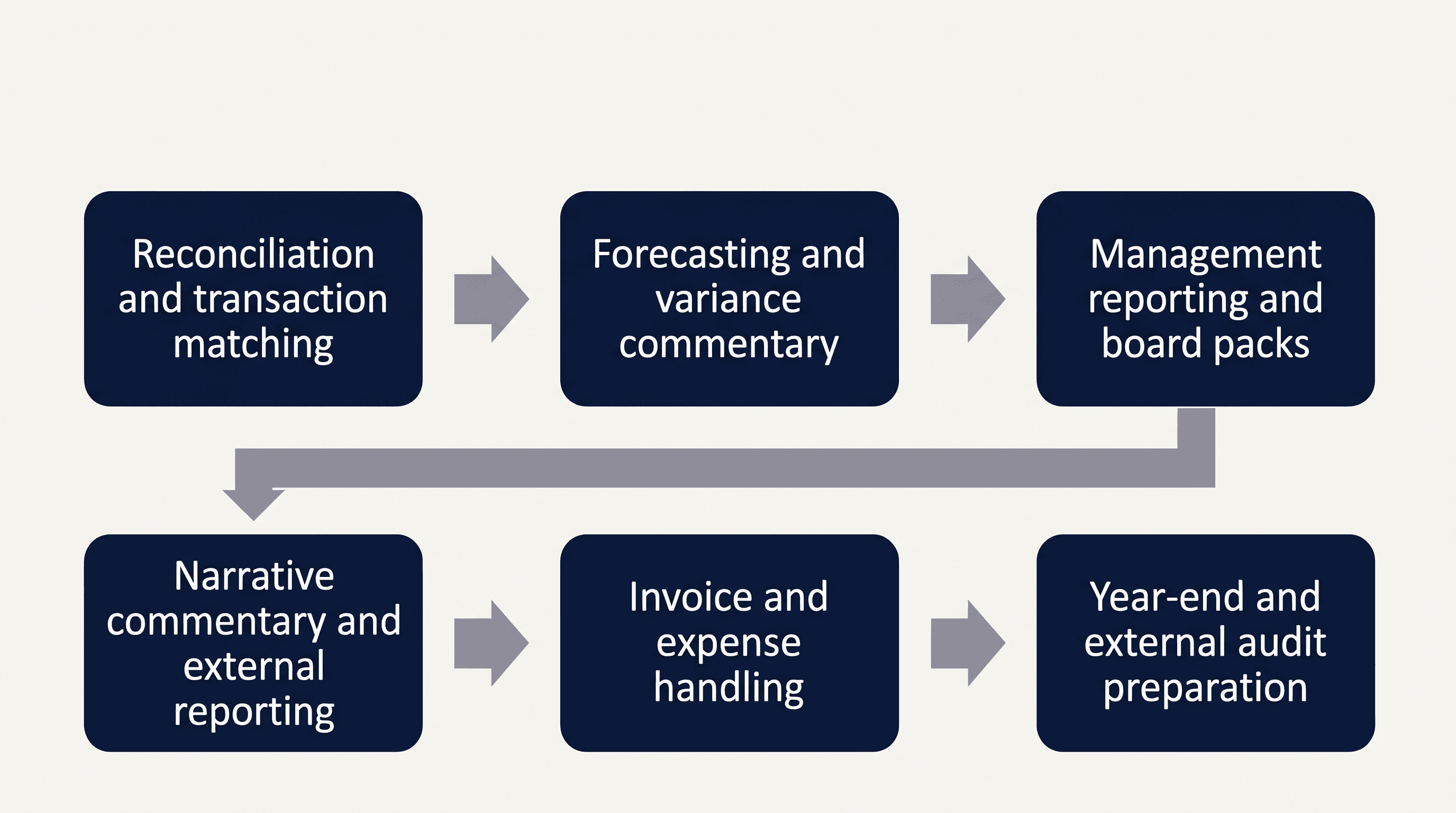
Reconciliation and transaction matching
How does a finance team get AI to sit inside the bank and ledger reconciliation routine without breaking the audit trail?
AI is good at suggesting matches, grouping likely duplicates, and flagging anomalies against recent history. It is not good at owning the sign-off. The workable pattern in a UK finance team is AI as a ranked proposal, a named reviewer on every variance, and a clear record of what AI suggested versus what the reviewer accepted. The ledger still carries a human signature; the cycle just runs shorter.
Forecasting and variance commentary
Can AI produce forecasts and explanations a Finance Director is willing to sign off to the board?
AI-assisted forecasting works best as a challenger to the existing model, not a replacement. A Finance Director running a three-statement model can use AI to stress-test assumptions, surface correlations the human missed, and draft first-pass variance commentary against the last close. The final number stays owned by the finance team, with the assumption register and the sensitivity table sitting alongside it.
Management reporting and board packs
What does AI safely do inside the monthly management pack, and where does the Financial Controller still need to step in?
AI drafts narrative commentary well when it is pointed at a structured data extract and a prior-month pack. It is fine for the first pass on movement explanations, cost-centre notes, and departmental summaries. It is not fine for the CFO letter, the opening statement, or anything with an exposure to forward-looking representation. Treat AI output as draft copy for a Financial Controller to edit, not as finished management information.
Narrative commentary and external reporting
Where does AI-assisted commentary stop, and where does ICAEW / CIMA / ACCA competence start?
The ICAEW, CIMA, and ACCA professional bodies expect members to apply skill, care, and independent judgement. That expectation is not removed by using AI. A member who signs narrative commentary is responsible for the content regardless of how much of the first draft came from a tool. The practical rule: every AI-assisted paragraph in external or statutory output is reviewed line by line by a named finance team member before it leaves the firm. See `/finance-and-accounting` for the broader competence framing.
Invoice and expense handling
Is AI a credible fix for the invoice and expense processing backlog without creating a fraud risk?
Invoice OCR and expense-categorisation AI tools are now mature enough for mid-market use. The risk is not the classification; it is the approval chain. A robust pattern keeps AI as the categorisation and flagging layer, the firm's approval matrix unchanged, and a periodic spot-check on the AI's categorisation against original documents. Any tool that writes directly to the general ledger needs explicit Finance Director approval and a documented rollback route.
Year-end and external audit preparation
How does AI make audit prep less painful without introducing new findings from the auditor?
AI is useful for assembling the prepared-by-client pack, drafting the memo on accounting judgements, and surfacing items that look inconsistent with prior year. External auditors will reasonably ask how AI was used and whether the outputs were reviewed. A Finance Director who wants a clean audit keeps a short written note on the AI tools in use, what they were used for, who reviewed the output, and where the firm drew the line between AI drafting and professional judgement.
This summary is descriptive, not accounting or audit advice. Firms should confirm their own position with their Finance Director, external accountant, ICAEW-, CIMA-, or ACCA-qualified adviser, and external auditor before adopting any AI tool inside a statutory or management reporting workflow. Learn AI is a trading style of The AI Consultancy (London) Ltd and does not provide audit or tax services.
Three ways a finance function can start
A sector workshop sized for the finance team, a leadership-level Executive Briefing, and a 90-day enablement programme. Each is scoped separately and priced transparently. Finance functions often start with the workshop and add enablement once the controls are in place.
AI for Finance Teams workshop
Half-day workshop for up to 20 finance staff, in-person or virtual. Built around UK finance workflows (month-end close, forecasting, reconciliation, management reporting) and vendor-neutral by design. Matches the offer described on the Finance & Accounting sector page.
Outcome
The finance team leaves able to use approved AI tools on appropriate workflows, with a named reviewer on every AI-touched number, a reconciliation checklist, and written guidance on what may and must not be pasted into a consumer-grade tool.
Price
£950 + VAT
Per session. Travel charged separately if delivered in person outside London.
Executive AI Briefing
Half-day briefing for 6 to 12 senior leaders, including the Finance Director alongside the Managing Partner, Operations Director, and Head of People. Sector-specific deck, pre-briefing call, written summary.
Outcome
The leadership team leaves with a defensible position on AI, a ranked shortlist of use cases (close, forecasting, reporting, reconciliation), a governance gap analysis against the firm's current controls, and named owners for the next step. Suited to firms where the finance function is driving the AI conversation for the wider business.
Price
£2,500
Per session.
90-Day Enablement
Kickoff workshop, bi-weekly office hours for 90 days, a curated prompt library tuned to the finance team's actual workflows, and an impact assessment at day 90.
Outcome
Adoption moves from individual experimenters to a supported team practice. At day 90 the firm has a documented record of which AI touches sat inside the audit trail, where measurable value appeared (cycle time, variance explained, reconciliation throughput), and a clear next step before any further investment decision.
Price
£8,000
For a team of 10 to 25 users over 90 days. Scoped in a pre-engagement call.
Questions a Finance Director asks before booking
Eight questions we hear most often from Finance Directors, Financial Controllers, and Heads of Finance. Straight answers, no regulatory claim we cannot defend.
How is this role page different from the Finance & Accounting sector page?
- The sector page at `/finance-and-accounting` is firm-typed: it is written for accountancy practices where finance is the product the firm sells. This role page is written for Finance Directors, Financial Controllers, and Heads of Finance working inside any firm, including law firms, consultancies, and marketing agencies. If the reader's firm is an accountancy practice, start on the sector page. If the reader runs the finance function inside a firm whose primary sector is something else, start here.
What does a Finance Director actually use AI for day to day in 2026?
- The steady state in UK mid-market finance teams in 2026 is AI as a drafting and triage layer across reconciliation, forecasting, management reporting, narrative commentary, invoice and expense handling, and year-end audit prep. It is a productivity layer, not a replacement for the audit trail or the Financial Controller's judgement. The six cards on this page describe the tasks and the boundaries Learn AI uses in the workshop.
Where does ICAEW, CIMA, or ACCA competence sit when AI drafts commentary?
- The professional bodies expect members to exercise professional scepticism, skill, and independent judgement. AI assistance does not transfer that expectation to the vendor. In practice, a member who signs off an AI-assisted paragraph is responsible for the content as though they had drafted it themselves. The workshop bakes this into every drafting use case: AI drafts, a named finance team member reviews, and the record of the review sits alongside the output.
Can AI sit inside the month-end close without breaking the audit trail?
- Yes, if the AI output is positioned as proposal rather than posting. The AI can rank likely reconciliation matches, surface variances against prior period, and draft commentary. A named reviewer signs off every AI-influenced entry, and the audit trail records what the AI proposed and what the human accepted. Any tool that writes directly to the general ledger needs explicit Finance Director approval, a documented rollback route, and a periodic spot-check by the Financial Controller.
What should a small finance team start with if they have never used AI at work?
- Start with drafting. Narrative commentary for the management pack, first-pass variance explanations, and prepared-by-client pack assembly are the lowest-risk entry points: the output is a draft a human edits, not a posting to the ledger. Keep consumer-grade tools away from statutory accounts, payroll, and director-loan material. The AI Readiness Assessment gives a tailored suggested starting sequence for teams of 2 to 15 people.
How should finance handle staff pasting payroll or director-loan data into consumer AI tools?
- Payroll records, director-loan ledgers, and statutory-accounts working papers are all personal or commercially sensitive data. Consumer-grade tools (free tiers of Gemini, ChatGPT, and Claude) may retain, train on, or route that data outside the firm's managed environment. The workable rule is a written guidance note: which categories of data may go into which tool, and what stays inside the firm's managed Microsoft or Google tenancy. The workshop produces a draft note the Finance Director can circulate.
What should a CFO tell the external auditor about AI use?
- An external auditor will reasonably ask how AI was used in the preparation of the accounts and the audit file. A short written note is usually enough: which tools, for which tasks, who reviewed the output, and where the firm drew the line between AI drafting and professional judgement. Learn AI does not represent firms to auditors or issue certificates of AI use; the firm owns that conversation with its own audit partner.
What does follow-up look like after the workshop or briefing?
- A written summary goes out within five working days, with a template guidance note the Finance Director can adapt. A thirty-minute follow-up call is offered at no additional cost. Further work (90-Day Enablement for the finance function, bespoke programmes) is priced separately and scoped only if the firm asks for it.
What finance leaders tell us after a workshop
Attributions anonymised at role and firm-type level until named clients sign a usage permission. Full case studies will follow in Phase 2.
“The workshop gave us language to tell the partnership where AI stops and the Financial Controller starts. That conversation had been going in circles for six months.”
Finance Director, UK commercial law firm (30 to 50 fee-earners)
“We had been pasting management information into a consumer chatbot without really thinking about it. The session made the boundary obvious and gave us a rule the team could actually follow.”
Financial Controller, UK consultancy (50 to 100 staff)
“First finance training I have done that treated the audit trail as a starting constraint, not an afterthought. That alone justified the half-day.”
Head of Finance, UK marketing agency group
Built for UK regulated teams
Three commitments we carry into every engagement. Professional-body alignments are pursued once we have case studies to substantiate them.
GDPR-compliant by design
Assessment data is stored in the UK, minimised by default, and retained only for the term stated in our privacy notice.
UK-based and UK-regulated
A trading style of The AI Consultancy (London) Ltd, registered in England and Wales. Trainers and associates are UK-based.
Vendor-neutral
No reseller commissions, no platform lock-in. Training covers the tools your firm uses, not the tools we are paid to promote.
Where finance leaders go next
Start with the Assessment, then follow the thread that matches where the firm is now. Each link is a dedicated page.
- Read more
Assessment
AI Readiness Assessment
Fifteen-minute diagnostic producing a personalised report on tool use, skills gaps, and a recommended next step for finance teams. Free, and a useful input to the pre-workshop call.
- Read more
Sector
AI for UK finance and accounting firms
Firm-typed sector page for accountancy practices. Covers the ICAEW / CIMA / ACCA competence frame, HMRC and MTD posture, and the full regulatory band that sits under finance-function AI use.
- Read more
Article
AI for UK finance teams
Cornerstone article covering reconciliation, forecasting, management reporting, and the five-dimension framework for evaluating AI tools against finance-team risk tolerance.
- Read more
Offer
Executive AI Briefing
Half-day briefing for 6 to 12 senior leaders including the Finance Director. Useful where the AI conversation needs to land at partnership or executive committee level, not just inside the finance function.