AI for UK law firms
AI training for managing partners and legal operations directors, with compliance built into every session
Sector-specific training and briefings for UK law firms with 10 to 100 fee-earners. Built around the two primary buying triggers: SRA competence obligations under the Code of Conduct for Solicitors, and the combined risk of confidentiality breach and AI hallucination in live client work. Delivered by UK-based, vendor-neutral facilitators through The AI Consultancy (London) Ltd.
- For firms with 10 to 100 fee-earners
- Vendor-neutral, no reseller commissions
- A trading style of The AI Consultancy (London) Ltd

Why AI competence is a live question for every UK law firm
The partnership is typically the least-prepared group in the firm, even though the regulatory responsibility for AI use on client matters sits with fee-earners. Every figure below carries its source and year.
- 81%
- of partners at UK legal firms are rated least prepared for AI adoption inside their own firm.
- 61%
- of professional services firms have abandoned at least one AI project, with skills gaps at leadership level cited as a primary cause.
- 97%
- of UK firms report an AI skills gap inside their own workforce, including the professional-services sector.
Source: Law Society AI readiness survey, 2025.
Source: Skills England / DSIT workforce research, 2025.
Source: IBM Institute for Business Value, 2024.
The SRA touchpoints a law firm has to consider before AI ships
Five regulatory areas every UK law firm should have a position on before fee-earners use AI tools on live matters. We do not claim alignment or endorsement from the SRA or the Law Society. This is the working map we use in the briefing and the workshop.
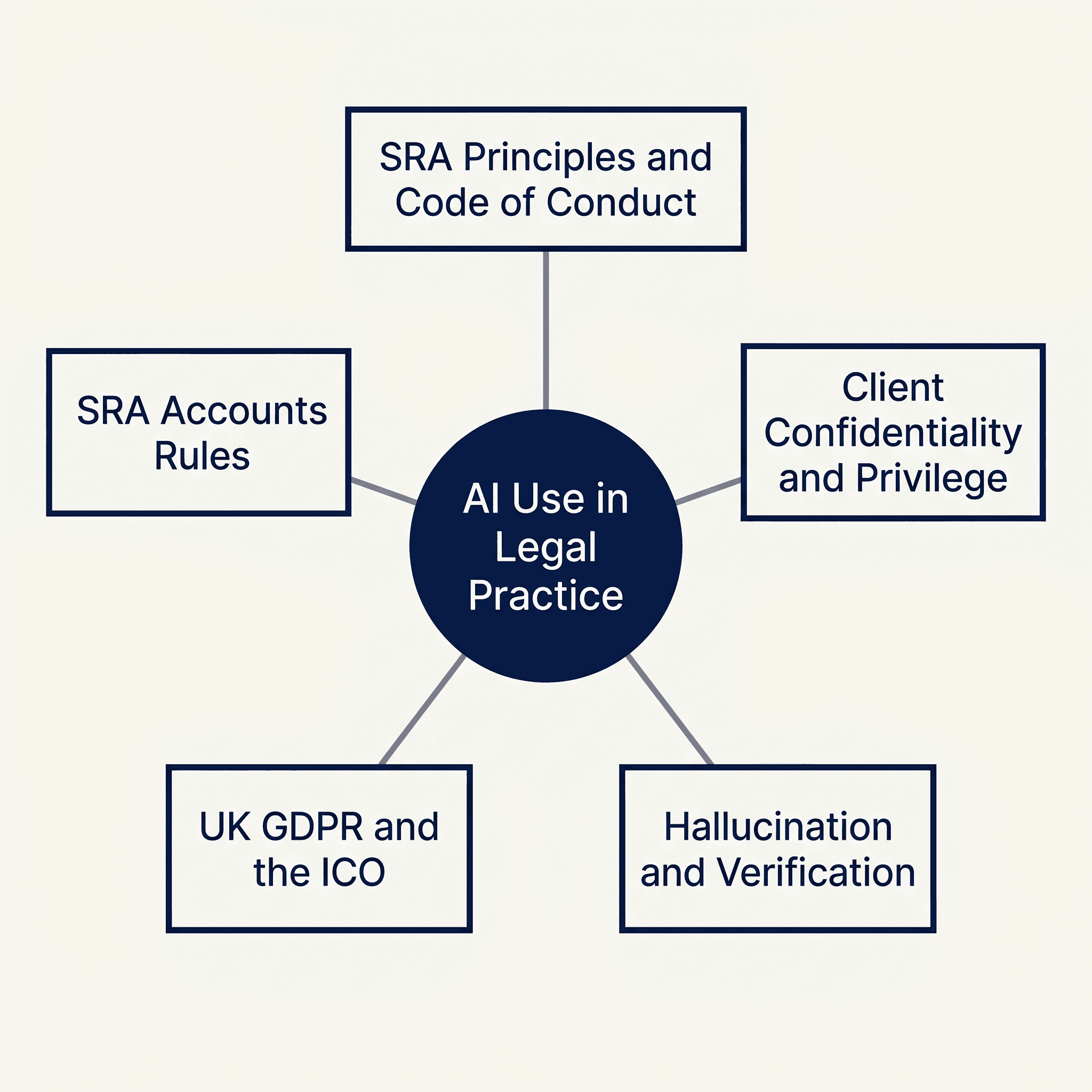
SRA Principles and Code of Conduct
Does the firm meet its competence obligations when fee-earners use AI tools?
SRA Principle 7 requires acting in the best interests of each client; the Code of Conduct for Solicitors requires maintaining competence and supervising delegated work. Fee-earners using AI tools still owe those duties personally. Training needs to evidence that competence, not assume it.
Confidentiality and legal professional privilege
Where does client-confidential material actually go when a fee-earner pastes it into an AI tool?
Confidentiality under the SRA Code of Conduct and privilege at common law both turn on control of the material. Consumer-grade AI tools may retain prompts, train on inputs, or route data across jurisdictions. The firm needs a clear answer, per tool, before fee-earners use it on client matters.
Hallucination and verification
How is the risk of fabricated citations, statutes, or case references controlled in practice?
English and Welsh courts have already sanctioned parties who filed documents containing AI-generated case citations that did not exist. The control is procedural: a named verification step before any AI-drafted output leaves the firm, with the fee-earner on record as the reviewer.
UK GDPR and the ICO
Is personal data processed by an AI tool covered by the firm's UK GDPR position?
Client matters routinely contain personal data. Using a new AI tool typically requires a lawful basis, a DPIA where the processing is high risk, a data processing agreement with the provider, and a record in the firm's Article 30 inventory. The ICO expects the firm, not the tool vendor, to hold that record.
Client money and the SRA Accounts Rules
Do AI workflows touch anything that interacts with client money?
For firms that hold client money, the SRA Accounts Rules sit alongside every operational change. AI tooling that touches billing narratives, disbursement coding, or client ledger entries needs the same four-eyes control the firm already applies to those workflows. The briefing flags this explicitly rather than leaving it to the AML partner to catch later.
This summary is descriptive, not legal advice. Firms should confirm their own position with their COLP, COFA, or external solicitor before adopting any AI tool. Learn AI is a trading style of The AI Consultancy (London) Ltd and does not provide legal services.
Three ways to start on the Legal track
A single entry workshop, a leadership-level briefing, and a 90-day enablement programme. Each is scoped separately and priced transparently. Firms often start with the workshop or the briefing and add enablement once the use cases are clear.
Secure AI for Fee-Earners
Half-day workshop for up to 20 fee-earners, in-person or virtual. Built around UK legal matter types and vendor-neutral by design: no reseller commissions and no platform lock-in.
Outcome
Fee-earners leave able to use approved AI tools on appropriate matters, with a named verification step, a confidentiality checklist, and written guidance on prompts that do and do not belong in a consumer-grade tool.
Price
£950 + VAT
Per session. Travel charged separately if delivered in person outside London.
Executive AI Briefing
Half-day briefing for 6 to 12 managing partners and legal operations directors. Sector-specific deck, pre-briefing call, written summary.
Outcome
The leadership team leaves with a defensible position on AI, a ranked shortlist of use cases, a governance gap analysis against the firm's current policy, and named owners for the next step.
Price
£2,500
Per session.
90-Day Enablement
Kickoff workshop, bi-weekly office hours for 90 days, a curated prompt library tuned to the firm's matter types, and an impact assessment at day 90.
Outcome
Adoption moves from individual experimenters to a supported team practice. At day 90 the firm has a documented record of what was used, measured value where it was measurable, and a clear next step before any further investment decision.
Price
£8,000
For a team of 10 to 25 users over 90 days. Scoped in a pre-engagement call.
Questions a managing partner asks before booking
Eight questions we hear most often from managing partners and legal operations directors. Straight answers, no regulatory claim we cannot defend.
What does the Secure AI for Fee-Earners workshop actually cover?
- A half-day working session for up to 20 fee-earners. It covers which AI tools belong on client matters and which do not, a confidentiality checklist for every matter type the firm runs, a named verification step for any AI-drafted output, and worked examples on common matter types (drafting, disclosure review, research, client correspondence). The output is a short written guidance note the firm can circulate internally.
How do you handle the SRA competence obligation in the training?
- The Code of Conduct for Solicitors requires fee-earners to maintain competence and supervise delegated work. AI tools do not change that obligation. The workshop treats competence as a procedural control: we walk through where AI fits in the matter lifecycle, where a qualified review is required, and how the firm evidences that the supervising fee-earner has taken responsibility for the output. We describe the regulatory position; we do not certify competence on the firm's behalf.
How do you address the risk of AI tools fabricating case law or statutes?
- This risk is real and has already led to sanctioned filings in England and Wales. The workshop treats it as a procedural control, not a tool selection exercise. Every AI-drafted output routed to a client or a court passes through a named verification step before it leaves the firm, and the fee-earner responsible for the matter is on record as the reviewer. We supply a template checklist firms can adopt.
How should fee-earners handle client-confidential material when using AI tools?
- The position depends on the tool. Consumer-grade tools may retain prompts, train on inputs, or route data across jurisdictions; enterprise tools often do not, but only when configured correctly. The workshop asks the firm to map its existing tool estate against confidentiality and UK GDPR requirements, then issues a plain-English rule set: what belongs in which tool, and what never leaves the firm's managed environment.
Which AI tools does the training cover, and are you tied to any vendor?
- Learn AI takes no reseller commissions and carries no platform lock-in. The delivery bench is trained across Microsoft Copilot, Google Gemini Workspace, Anthropic Claude, and OpenAI ChatGPT, and sessions focus on the tools your firm already runs rather than promoting a single vendor. We are happy to put the commercial position in writing before booking.
Who delivers the sessions, and what are their credentials?
- A facilitator from the Learn AI delivery bench: either a senior associate from The AI Consultancy (London) Ltd or a certified partner trained against the same agenda. We confirm the named facilitator in writing before booking. Delivery is by certified associates rather than a single individual; the firm is not dependent on any one person's availability.
What regulatory claim does the workshop make, and what does it not claim?
- We describe the SRA Principles, the Code of Conduct obligations, UK GDPR and ICO requirements, and where the firm's own policies intersect with AI use cases. We do not claim accreditation, endorsement, or CPD-compatibility from the SRA, the Law Society, or any other professional body unless that body has confirmed alignment to us in writing. Any copy that would bind the firm should be reviewed by the firm's COLP, COFA, or external solicitor.
What does follow-up look like after the workshop?
- The session concludes with a written summary and a template guidance note, typically sent within five working days. A thirty-minute follow-up call is offered at no additional cost. Further work (Executive AI Briefing for the partnership, 90-Day Enablement for a named team, bespoke programmes) is priced separately and scoped only if the firm asks for it.
What partners tell us after a legal workshop
Attributions anonymised at role and firm-type level until named clients sign a usage permission. Full case studies will follow in Phase 2.
“The workshop did not sell us a tool. It told us which of the three we had already bought was the one fee-earners could safely use on client matters.”
Managing Partner, UK commercial law firm (20 to 50 fee-earners)
“Our COLP walked in sceptical and left as the one pushing the adoption plan. That alone was worth the fee.”
Senior Partner, mid-size UK law firm
“First AI training we have run where the verification step was treated as part of the work, not a disclaimer at the end of the deck.”
Head of Legal Operations, UK law firm (30 to 50 fee-earners)
Built for UK regulated teams
Three commitments we carry into every engagement. Professional-body alignments are pursued once we have case studies to substantiate them.
GDPR-compliant by design
Assessment data is stored in the UK, minimised by default, and retained only for the term stated in our privacy notice.
UK-based and UK-regulated
A trading style of The AI Consultancy (London) Ltd, registered in England and Wales. Trainers and associates are UK-based.
Vendor-neutral
No reseller commissions, no platform lock-in. Training covers the tools your firm uses, not the tools we are paid to promote.
Start where you are
Pick the first step that matches where your firm is now. Each links through to a dedicated page.
- Read more
Article
AI in UK legal research: verification, sanctions, and the SRA
Where AI research sits in the UK stack, what hallucination looks like, what UK courts and the SRA have said, and the five-step verification workflow a firm adopts.
- Read more
Assessment
AI Readiness Assessment
Fifteen-minute diagnostic producing a personalised report on tool use, skills gaps, and recommended next steps. Free, and a useful input to a pre-workshop call.
- Read more
Case study
UK commercial law firm embeds a verification step
Anonymised case study from a UK commercial law firm (20 to 50 fee-earners). Secure AI for Fee-Earners workshop, one written guidance note, consumer-grade AI use on client matters closed off inside six weeks.