AI for UK property, lettings, and conveyancing firms
AI training for Managing Directors, Compliance Officers, and Lettings Directors at UK property firms, with AML, Renters' Rights, and CMA built into every session
Sector-specific training and briefings for UK estate agencies, lettings businesses, property management firms, conveyancing practices, and hybrid proptech firms at mid-market scale with 20 to 500 employees. Built around the three primary buying triggers: Money Laundering Regulations exposure when AI tools sit inside the onboarding pipeline, Renters' Rights Act 2026 audit-trail obligations on AI-drafted tenant communications, and Consumer Rights Act exposure on AI-generated listings. Delivered by UK-based, vendor-neutral facilitators through The AI Consultancy (London) Ltd.
- For property firms with 20 to 500 employees
- Vendor-neutral, no reseller commissions
- A trading style of The AI Consultancy (London) Ltd

Why AI governance is a live question for every UK property firm
Property firms sit at an awkward intersection on AI governance: HMRC-supervised AML obligations, tenant-facing communications under the Renters' Rights Act, listing-copy exposure under the Consumer Rights Act, and UK GDPR on tenant and applicant data all converge on the Managing Director's desk. Every figure below carries its source and year.
- 97%
- of UK firms report an AI skills gap inside their own workforce, including estate agency, lettings, property management, and conveyancing teams.
- 61%
- of professional services firms have abandoned at least one AI project, with skills gaps at leadership level cited as a primary cause.
- 55%
- of C-suite leaders in professional services rate themselves as the least prepared group in their firm for AI adoption, including on listing quality, AML decisions, and tenant-facing communications.
Source: IBM Institute for Business Value, 2024.
Source: Skills England and DSIT workforce research, 2025.
Source: Skills England and DSIT workforce research, 2025.
The HMRC, RICS, Propertymark, CMA, and ICO touchpoints a UK property firm has to consider before AI ships
Six regulatory and professional-standards areas every UK estate agency, lettings business, property management firm, or conveyancing practice should have a position on before AI tools touch listings, tenant communications, onboarding, or valuation sign-offs. We describe where the rulebook is, what named UK guidance says, and where the firm carries the accountability. We do not claim alignment or endorsement from RICS, ARLA Propertymark, NAEA Propertymark, or any other body.
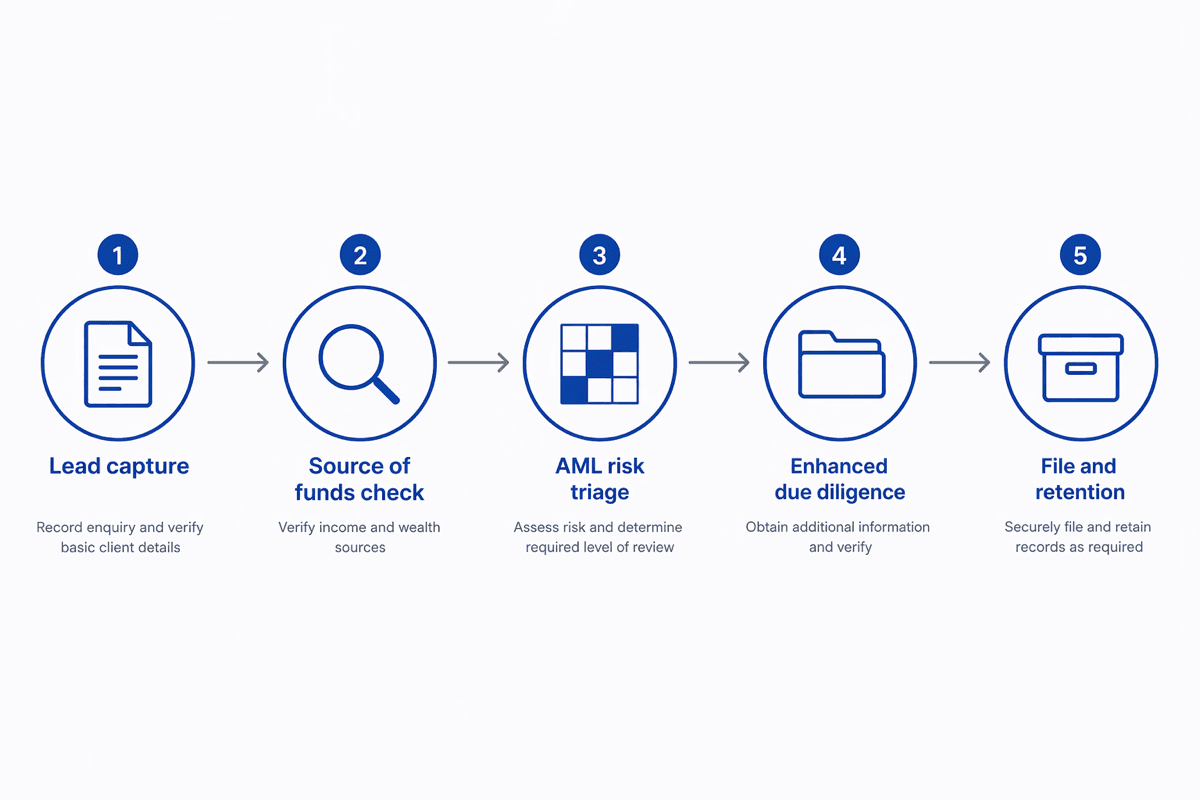
Money Laundering Regulations 2017 and HMRC supervision for estate agency
Do AI-assisted lead generation, onboarding, or source-of-funds workflows meet the obligations in the firm's HMRC-supervised AML regime?
Estate Agency Businesses are a regulated sector under the Money Laundering, Terrorist Financing and Transfer of Funds (Information on the Payer) Regulations 2017 (as amended) and are supervised by HMRC. AI tools that triage leads, draft customer due diligence questionnaires, or flag source-of-funds risk indicators still sit inside the firm's risk-based AML controls. The firm (not the vendor) holds the registration, and the firm's Money Laundering Reporting Officer remains accountable for SAR filings and onboarding decisions.
Renters' Rights Act 2026 and possession-ground evidencing
Does the firm's record-keeping for AI-drafted notices, correspondence, and evidence meet the retention expectations under the new possession-ground framework?
The Renters' Rights Act 2026 abolished the old Section 21 regime and replaced it with reformed grounds for possession under Section 8, each with its own evidential requirements. AI-assisted drafting of notices, tenant correspondence, and inspection records is compatible with the framework but only where the audit trail is preserved. Where an AI tool produces the text that appears in a possession notice, the firm needs a record of who reviewed the output, on which property, and against which ground before service.
Tenant Fees Act 2019 and the listing-to-letting pipeline
Where AI drafts referencing questions, offer letters, or tenant communications, can the firm evidence that no prohibited fee or prohibited wording has entered the pipeline?
The Tenant Fees Act 2019 bans most fees from landlords or agents to tenants except permitted payments listed in the Act (rent, refundable tenancy deposit capped at the statutory maximum, holding deposit capped at one week's rent, and specified default fees). AI tools drafting tenant communications can inadvertently introduce wording that would be treated as an unlawful charge. The firm's compliance control has to catch this before the communication goes out.
Consumer Rights Act 2015 and CMA guidance on misleading property listings
Can the firm defend the accuracy of AI-generated listing copy, floorplan descriptions, and marketing photographs against the Consumer Rights Act 2015 and CMA guidance?
The Consumer Rights Act 2015 and the Consumer Protection from Unfair Trading Regulations 2008 prohibit misleading actions and omissions in trader-to-consumer transactions, including residential property marketing. The CMA's 2013 guidance and its 2019 update on property lettings set named expectations on factual accuracy in marketing. AI-generated listing copy that invents features, embellishes measurements, or cleans up property condition without a verification step is a direct exposure under both the Consumer Rights Act and the Consumer Protection Regulations.
UK GDPR on tenant, applicant, buyer, and seller personal data
Is the lawful basis for processing personal data across the lettings and sales funnel, and the retention period for unsuccessful applicants, documented before AI tools see it?
Prospect, applicant, buyer, seller, tenant, and referencing data is personal data under UK GDPR. Processing sits under legitimate interests or, for concluded transactions, performance of a contract. Unsuccessful applicant data has a finite retention period, usually twelve to twenty-four months depending on defensibility under the Equality Act and the firm's own documented policy. AI tooling that retains applicant material beyond the firm's documented retention, or trains a third-party model on it, is a compliance finding the firm needs to catch at procurement, not after it.
RICS and Propertymark professional competence where AI overlaps surveying and valuation
Where AI output touches a regulated activity (a Red Book valuation, a Chartered Surveyor's inspection, a Propertymark-qualified agent's sign-off), is the professional-competence line clear?
RICS members operate under the RICS Rules of Conduct (2022) and the Red Book Global Standards on valuation, and Propertymark members operate under the Propertymark Conduct and Membership Rules. Both sets of expectations require the regulated professional to apply their own judgement on the output. AI tools that draft a valuation narrative, a condition report, or a Propertymark-qualified sign-off do not discharge the obligation on the regulated individual. The firm needs a clear line between AI-assisted drafting and professional sign-off.
This summary is descriptive, not legal, regulatory, or valuation advice. Firms should confirm their own position with their Managing Director, Compliance Officer, Money Laundering Reporting Officer, General Counsel, or external solicitor before adopting any AI tool in a regulated property workflow. Learn AI is a trading style of The AI Consultancy (London) Ltd and does not provide legal, regulatory, or valuation advice.
Three ways to start on the Property & Estate Agency track
A dedicated property workshop, a leadership-level briefing, and a 90-day enablement programme. Each is scoped separately and priced transparently. Property firms typically start with the workshop because the AML, listing-accuracy, and tenant-communications exposure sits primarily at desk level.
AI for compliant estate agency
Half-day workshop for up to 20 sales agents, lettings agents, property managers, compliance officers, and Money Laundering Reporting Officers. In-person or virtual. Built around UK property workflows (listing generation, AML triage, tenant referencing, conveyancing document assembly) and vendor-neutral by design.
Outcome
The firm leaves with a written position on where AI may and may not enter property-facing decisions, an AML workflow note for the onboarding pipeline, a listing-copy verification step inside the marketing workflow, a tenant-communications compliance check against the Tenant Fees Act 2019 and the Renters' Rights Act 2026, and a named owner for the ongoing governance of each AI tool.
Price
£950 + VAT
Per session. Travel charged separately if delivered in person outside London.
Executive AI Briefing
Half-day briefing for 6 to 12 Managing Directors, Lettings Directors, Conveyancing Partners, and senior leaders at UK property firms. Sector-specific deck, pre-briefing call, written summary.
Outcome
The leadership team leaves with a defensible position on AI across sales, lettings, property management, and conveyancing; a ranked shortlist of use cases; a governance gap analysis against the firm's current AML, Consumer Rights Act, and UK GDPR posture; and named owners for the next step.
Price
£2,500
Per session. Confirmed in writing before booking.
90-Day Enablement
Kickoff workshop, bi-weekly office hours for 90 days, a curated prompt library tuned to the firm's property workflows (listing drafting, tenant correspondence, AML triage, market appraisals), and an impact assessment at day 90.
Outcome
Adoption moves from individual experimenters to a supported firm practice. At day 90 the firm has a documented record of where AI touched marketing, AML, tenant correspondence, or valuation output; measurable indicators (time-to-list, referencing turnaround, tenant-correspondence volume); and an evidenced compliance review before any further rollout decision.
Price
£8,000
For teams of 10 to 25 users over 90 days. Scoped in a pre-engagement call.
Questions a Managing Director asks before booking
Eight questions we hear most often from Managing Directors, Compliance Officers, Lettings Directors, and Conveyancing Partners. Straight answers, no regulatory claim we cannot defend.
What does the AI for compliant estate agency workshop actually cover?
- A half-day working session for up to 20 sales agents, lettings agents, property managers, compliance officers, and Money Laundering Reporting Officers. It covers the property AI use case landscape (listing generation, lead triage, AML red flags, tenant referencing, conveyancing document assembly), an AML workflow review against the Money Laundering Regulations 2017, a listing-copy verification step for AI-drafted marketing, a Tenant Fees Act 2019 and Renters' Rights Act 2026 check on AI-drafted tenant communications, UK GDPR on applicant retention, and a named owner for each AI tool in the stack. The output is a short written guidance note the firm can circulate internally.
How do you handle the Money Laundering Regulations 2017 in the training?
- Estate Agency Businesses are a regulated sector under the Money Laundering, Terrorist Financing and Transfer of Funds (Information on the Payer) Regulations 2017 (as amended) and are supervised by HMRC. The workshop walks the firm through how AI tools in the onboarding pipeline, source-of-funds triage, and PEP / sanctions screening interact with the firm's risk-based AML controls. The Money Laundering Reporting Officer remains the accountable individual; the training describes the tooling implications without taking that accountability on the firm's behalf.
How do you handle the Renters' Rights Act 2026 possession-ground framework?
- The Renters' Rights Act 2026 abolished the old Section 21 regime and replaced it with reformed grounds for possession under Section 8, each with distinct evidential requirements. The workshop walks through where AI-assisted drafting of notices, tenant correspondence, and inspection records is compatible with the framework, where it introduces audit-trail gaps, and what the firm would say to a First-tier Tribunal (Property Chamber) if the evidence chain on an AI-drafted notice were tested. The output is a retention and review-point checklist for the lettings team.
How do you address CMA and Consumer Rights Act exposure on AI-generated listings?
- The Consumer Rights Act 2015 and the Consumer Protection from Unfair Trading Regulations 2008 prohibit misleading actions and omissions in trader-to-consumer transactions, including residential property marketing. The CMA's 2013 guidance on property sales and its 2019 update on lettings set named expectations on factual accuracy in listings. The workshop asks the firm to run its current AI-drafted listing workflow against those expectations, to add a verification step against the inspection record, and to produce a short internal rule on which attributes the AI may draft, which it may summarise, and which must come directly from the inspection.
What does UK GDPR require on tenant, applicant, buyer, and seller data?
- Prospect, applicant, buyer, seller, and tenant data is personal data under UK GDPR. Processing usually sits under legitimate interests, or under performance of a contract once the transaction is concluded. Unsuccessful applicant data has a finite retention period (commonly twelve to twenty-four months, documented in the firm's own policy). The workshop asks the firm to map the AI tools it actually uses, the applicant data those tools retain, and the retention position the firm can defend in front of the ICO. Findings become an action list for the Data Protection Officer or senior compliance lead.
Which AI tools does the training cover, and are you tied to any vendor?
- Learn AI takes no reseller commissions and carries no platform lock-in. The delivery bench is trained across Microsoft Copilot, Google Gemini Workspace, Anthropic Claude, and OpenAI ChatGPT, as well as the main property-specific AI overlays (AI listing assistants inside ATS / CRM platforms, AI referencing tools, AI lead-qualification assistants, AI inspection-report drafters). Sessions focus on the tools your firm already runs rather than promoting a specific vendor. We are happy to put the commercial position in writing before booking.
What regulatory claim does the workshop make, and what does it not claim?
- We describe the Money Laundering Regulations 2017 (as amended), HMRC supervision of Estate Agency Businesses, the Tenant Fees Act 2019, the Renters' Rights Act 2026, the Consumer Rights Act 2015, the Consumer Protection from Unfair Trading Regulations 2008, the CMA's 2013 and 2019 guidance on property sales and lettings, UK GDPR (including Article 22 on automated decision-making where applicable), the RICS Rules of Conduct 2022 and Red Book Global Standards, and the Propertymark Conduct and Membership Rules. We do not claim accreditation, endorsement, or approved-provider status from RICS, ARLA Propertymark, NAEA Propertymark, The Property Ombudsman, or The Property Redress Scheme unless that body has confirmed alignment to us in writing. Any copy that would bind the firm should be reviewed by the firm's Managing Director, Compliance Officer, Money Laundering Reporting Officer, General Counsel, or external solicitor.
What does follow-up look like after the workshop?
- The session concludes with a written summary and a template guidance note, typically sent within five working days. A thirty-minute follow-up call is offered at no additional cost in the four weeks after the session. Further work (Executive AI Briefing for the leadership team, 90-Day Enablement for a named team, bespoke programmes) is priced separately and scoped only if the firm asks for it.
What property leaders tell us after a workshop
Attributions anonymised at role and firm-type level until named clients sign a usage permission. Full case studies will follow in Phase 2.
“The listing-copy block alone was worth the fee. We identified three properties where the AI draft had introduced features that were not in the inspection file, and we added a verification step before anything goes live.”
Managing Director, UK estate agency (40 to 100 staff)
“We did not know that our referencing partner was running tenant applications through a consumer AI tool. The workshop made that visible and gave us the rule to stop it.”
Compliance Officer, UK lettings business (100 to 250 staff)
“Straight answers on how the Renters' Rights Act possession-ground framework interacts with AI-drafted notices, without the scare tactics. We walked out with a one-page checklist the lettings team could actually use.”
Lettings Director, UK property management firm (50 to 100 staff)
Built for UK regulated teams
Three commitments we carry into every engagement. Professional-body alignments are pursued once we have case studies to substantiate them.
GDPR-compliant by design
Assessment data is stored in the UK, minimised by default, and retained only for the term stated in our privacy notice.
UK-based and UK-regulated
A trading style of The AI Consultancy (London) Ltd, registered in England and Wales. Trainers and associates are UK-based.
Vendor-neutral
No reseller commissions, no platform lock-in. Training covers the tools your firm uses, not the tools we are paid to promote.
Start where you are
Pick the first step that matches where your firm is now. Each links through to a dedicated page.
- Read more
Assessment
AI Readiness Assessment
Fifteen-minute diagnostic producing a personalised report on tool use, skills gaps, and recommended next steps. Free, and a useful input to a pre-workshop call.
- Read more
Article
AI in UK property and estate agency: what managing directors need to know
Where AI is being used in UK property in 2026, how the Money Laundering Regulations 2017 apply to AI output, what the Renters' Rights Act 2026 does to possession evidencing, the CMA position on AI-generated listings, and UK GDPR for tenant and applicant data.
- Read more
Sector
AI for UK marketing and agencies
UK GDPR and PECR, the ASA CAP Code substantiation rules, copyright and IP ownership of AI-generated creative. Relevant where the property firm runs its own in-house marketing or works with an external agency.
- Read more
Article
AI procurement in the UK: a due-diligence framework
UK GDPR, DPIAs, sub-processors, ICO and NCSC guidance, and what UK procurement teams do next. Relevant where property firms buy AI overlays into the lettings, referencing, or AML workflow.