Cornerstone article
The UK AI Skills Gap in 2026
What 2024 and 2025 research says about the UK AI skills gap, why the senior-leader gap matters most, and what UK professional services firms do next.
By Dee Khabra, Founder, The AI Consultancy (London) Ltd.
Published · Reading time approximately 9 minutes.
Across 2024 and 2025, three independent UK and international research sources converged on the same conclusion: UK professional services firms do not have an AI tools problem in 2026. They have an AI skills problem, and it sits more sharply at the top of the firm than at the bottom. This article sets out what the data actually says, why the senior-leader gap matters more than the workforce gap, where the gap shows up in daily work across legal, finance, and consulting, and what closes it.
What does the data actually say about the UK AI skills gap?
The UK AI skills gap in 2026 is wide, recent, and concentrated in places the headline figures do not always show. Four figures from three independent research sources set out the shape of the problem.
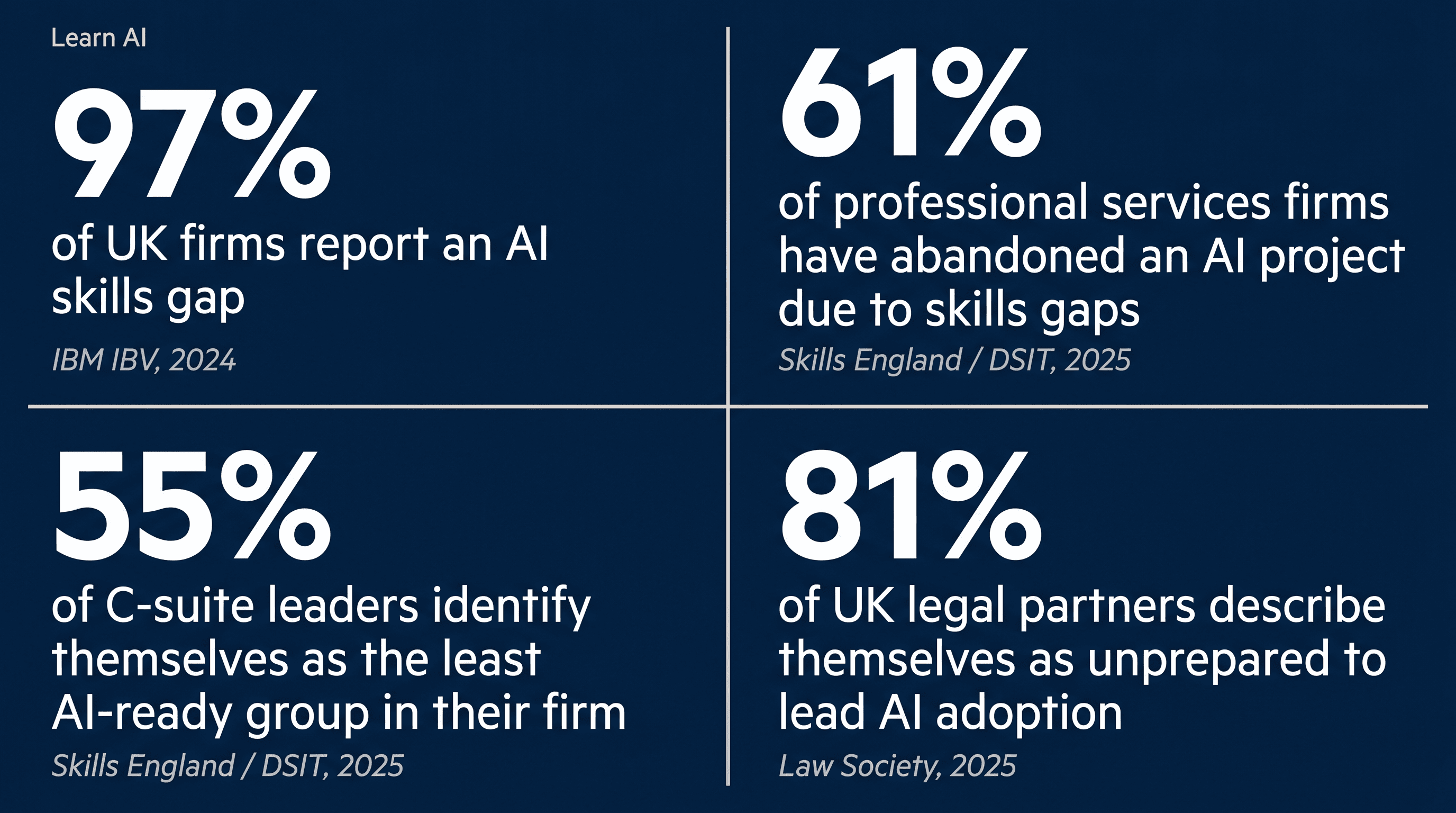
Ninety-seven per cent of UK firms report an AI skills gap somewhere in their own workforce (IBM Institute for Business Value, 2024). The figure is effectively universal inside the UK's mid-market professional-services layer and is not concentrated in a single sector.
Sixty-one per cent of professional services firms have abandoned at least one AI project because of skills gaps at leadership level (Skills England and the Department for Science, Innovation and Technology workforce research, 2025). That matters more than the headline adoption figures because it captures what happens after the proof-of-concept rather than before it. Firms are not standing still on AI. They are buying tools, running pilots, and then running into a wall that is not about the tool.
Fifty-five per cent of C-suite leaders in professional services rate themselves the least-prepared group in their firm for AI adoption (Skills England and the Department for Science, Innovation and Technology workforce research, 2025). That figure is not a statement about the workforce. It is a statement about the people who sign off the budget.
Eighty-one per cent of partners at UK legal firms are rated least prepared for AI adoption inside their own firm (Law Society AI readiness survey, 2025). The pattern holds inside the narrowest definition of professional services as well as the broadest.
Read together, the four figures describe a market that has already bought tools, has already tried projects, has already hit a wall at leadership level, and does not know what to do next.
A caveat is worth naming. None of these figures tell you whether the AI projects that did land produced measurable commercial value. They tell you about readiness, abandonment, and self-assessed preparedness. They do not tell you about return. That is partly because the UK professional-services market is still too early in its adoption cycle for reliable ROI data at the firm level, and partly because firms that do see value rarely publish the evidence. Both of those gaps will close over 2026 and 2027. The skills gap is the larger and more immediate constraint today.
Why the senior-leader gap matters more than the workforce gap
The workforce gap is real and manageable. The senior-leader gap is the one that kills AI projects in professional-services firms, because the partnership and executive committee control four of the levers that decide whether AI gets used safely and usefully.
The first lever is budget. If partners do not understand the use cases that are realistic for their sector, they underspend on the training that would close the gap and overspend on vendor tools that nobody in the firm has been trained to use securely. The 61% abandonment figure above is the visible tail of that pattern.
The second lever is governance. In UK professional services, governance cannot sit only with the IT team. The Solicitors Regulation Authority expects fee-earners to remain competent and supervise delegated work. The Information Commissioner's Office expects controllers to know what personal data is going where, and on what lawful basis. The Institute of Chartered Accountants in England and Wales expects members to evidence professional competence on any work that bears their name. HMRC expects an audit trail on anything touching statutory accounts or tax work. Partners and directors own those obligations in law. The IT team can operationalise them; it cannot own them.
The third lever is risk appetite. Someone in the firm has to decide what it will and will not do with AI in front of clients, and that decision cannot be delegated to a product manager, a trainee, or an intern. The Law Society's 81% figure is a direct measure of the people who are expected to make that call and report that they feel unprepared to make it.
The fourth lever is hiring and promotion. If AI fluency is not built into what "good" looks like for an associate, a management accountant, or a senior consultant, it will not land. The competency framework, the appraisal rubric, and the utilisation target all sit with the partnership and the people function, not with the firm's early AI adopters.
This is why the Executive Briefing format exists as a specific product. Half a day, six to twelve senior leaders, sector-specific, vendor-neutral, with governance built in. If your partnership is currently debating whether AI is worth a serious investment of firm time, the Executive AI Briefing for UK partners and directors is designed to collapse that debate into a defensible position in a single session.
Where the skills gap shows up in everyday professional-services work
The gap is rarely theoretical. It shows up as concrete moments of hesitation, duplication, and risk inside the matter, the engagement, or the month-end close. Three sector-specific examples make the pattern visible.
In legal work, the gap shows up when a fee-earner does not know whether pasting a sensitive document into a consumer-grade AI tool breaches the firm's confidentiality obligations, and when the managing partner does not know whether the firm has a defensible answer to that question. It shows up again when a trainee drafts a piece of research using a tool that has fabricated a case citation, and the supervising solicitor does not know to check. The Law Society's 81% figure is the same pattern, expressed as a number. The AI training track for UK law firms is built around the SRA Principles and Code of Conduct, UK GDPR and the ICO, and the specific risks of AI hallucination in citation-sensitive work.
In finance and accounting, the gap shows up when a management accountant prototypes a Copilot-generated reconciliation workflow that nobody else in the team knows how to audit or sign off under Making Tax Digital. It shows up again when an AI-drafted management pack is circulated to the board with no named reviewer and no visible audit trail. The ICAEW, CIMA, and ACCA expectation of professional competence does not weaken because the draft was AI-assisted. The AI training track for UK finance and accounting teams treats accuracy, evidencing, and the audit trail as part of the work rather than an afterthought.
In consulting and advisory work, the gap shows up when an analyst ships an AI-drafted client deck with a fabricated statistic buried on slide 17, and the partner who signs the deck for the client did not know to look. It shows up again in engagement-letter and master services agreement language that was not written with generative AI in mind, leaving IP ownership of AI-assisted deliverables and the client's confidentiality expectations ambiguous. The AI training track for UK consultancy and advisory firms works through confidentiality, deliverable-quality review, IP positioning, and partner-level sign-off as named procedural controls.
In every case, the gap is observable, fixable, and closer to the partnership than it feels from inside the firm.
What closes the gap, and what does not
Sector-specific training with governance built into the format closes the gap. Generic AI webinars and vendor tool demonstrations do not.
What does not close the gap, based on the 2024 and 2025 research and on the pattern the abandonment figures describe:
- Horizontal tool demos across five or six different AI platforms. Professional-services leaders do not need to see more tools. They need to decide how a small set of tools fits inside the firm's regulatory posture and how fee-earners or analysts use them on live work.
- Motivational keynotes about the future of work. The workforce already knows AI is coming. The partnership needs a defensible position and a named owner, not a vision statement.
- Off-the-shelf e-learning libraries. Completion rates are high and behavioural change is minimal, because the content is not tied to the real matters, clients, deliverables, and governance constraints of the firm.
- Single-vendor training delivered by the vendor's own channel team. The firm comes out better informed about that vendor's product roadmap and no closer to a defensible, cross-tool, sector-specific AI position.
What does close the gap, in the firms that have made it land:
- Half-day Executive Briefings that produce a written, partner-level position on AI. The output is a position the partnership can defend to a client, a regulator, and an insurer, not a tool survey or a compliance disclaimer.
- Sector-specific workshops that treat the firm's regulatory anchors (SRA, ICAEW, CIMA, ACCA, ICO, HMRC, UK GDPR) as governance, not disclaimers tacked onto the last slide.
- Named procedural controls for every AI-assisted output that leaves the firm. A verification step, a reviewer on the record, a checklist, a paper trail.
- Follow-up that lands. A written guidance note, a named owner for the first thirty days of embedding, and a measurable indicator that tells the firm whether the position held in practice.
None of this is new. It is the shape of every other professional-services change programme that has ever worked. AI is not an exception to that rule. The failure mode the 61% abandonment figure describes is the failure to apply the rule.
How to find out where your firm actually sits
Start with a fifteen-minute diagnostic, not a six-month transformation programme.
The AI Readiness Assessment produces a personalised report covering the firm's current AI maturity, the use cases that are realistic for the firm's sector and role, the governance gaps to close, and a recommended next step. It is free, it takes about fifteen minutes, and it does not require a technical lead to complete.
The diagnostic is designed to be the lowest-cost way to test whether your firm's current position on AI is defensible, actionable, and tied to the regulatory anchors that actually govern the firm's work. If the result suggests that a half-day Executive AI Briefing is the right wedge, the report says so and links through. If it suggests that a half-day sector workshop for fee-earners, finance teams, or consultants is the better next step, the report says that instead. If it says that the firm already has an AI position and just needs an impact measurement pass, the report says that too.
The UK AI skills gap is not closing on its own, and the 2024 and 2025 research shows that the gap sits hardest where the decisions are made. The firms that treat that as a leadership question, not a training-budget line item, are the firms that will not be buying the same AI tools for the third time in 2027.